


Use CTAL-TM-001 Exam Dumps (2026 PDF Dumps) To Have Reliable CTAL-TM-001 Test Engine
CTAL-TM-001 PDF Recently Updated Questions Dumps to Improve Exam Score
CTAL-TM Certification Path
6 months of experience in Software development/software testing. Successful completion of the ISTQB Certified Tester Foundation level and a minimum of three years testing experience is recommended. The Intermediate Certificate may also be helpful but is not required.
For more info visit:
NEW QUESTION # 10
What is the purpose of tracking efficiency metrics for a formal review?
- A. These metrics can be used to determine who participated in the review.
- B. These metrics can be used to determine if the review was a good use of resources.
- C. These metrics can be used to determine the quality of the reviewed object.
- D. These metrics can be used to determine the speed with which defects were fixed.
Answer: B
Explanation:
Efficiency metrics for a formal review are used to measure the cost-effectiveness of the review process, such as the time spent on the review, the number of defects found, and the return on investment1. These metrics can help to evaluate if the review was a good use of resources, such as human effort, money, and tools.
Therefore, option B is the correct answer. Option A is incorrect because efficiency metrics do not track who participated in the review, but rather how they performed. Option C is incorrect because efficiency metrics do not measure the quality of the reviewed object, but rather the quality of the review process. Option D is incorrect because efficiency metrics do not measure the speed with which defects were fixed, but rather the speed with which defects were detected. References: 1: How to manage formal reviews & management audits? Skills,metrics ...
NEW QUESTION # 11
You have been asked to estimate the testing effort for an upgrade to a legacy product Your team did the testing on the last upgrade, and you have ascertained that this upgrade is about 10% bigger than the last one Given this information which estimation technique should you use to come up with the test effort number?
- A. Planning poker
- B. Function points
- C. Three-point estimation
- D. Extrapolation
Answer: D
Explanation:
* Estimation Technique Selection:
* Extrapolation uses historical data from similar projects to estimate effort for a new one.
* Since the current upgrade is 10% larger than the previous one, extrapolation is the most straightforward method.
* Evaluation of Options:
* A(Function points) focuses on size estimation and is not specific to historical data.
* C(Planning poker) andD(Three-point estimation) involve collaborative or probabilistic techniques, not a direct extrapolation.
* Bis correct as it directly applies historical project data to estimate effort.
References and Syllabus Alignment:
* Effort estimation techniques are covered under "Test Estimation" (TM-2.2.1) in the syllabus.
NEW QUESTION # 12
A test log is one of the documents that need to be produced in this domain in order to provide evidence of testing. However, the level of detail of test logs can vary. Which of the following is NOT an influencing factor for the level of detail of the test logs being produced? 1 credit
- A. Level of test execution automation
- B. Experience level of testers
- C. Test level
- D. Regulatory requirements
Answer: B
NEW QUESTION # 13
Identify the THREE types of formal peer reviews that can be recognized. 1 credit
- A. Inspection
- B. Audit
- C. Informal review
- D. Management review
- E. Assessment
- F. Technical review
- G. Walkthrough
Answer: A,F,G
Explanation:
Explanation/Reference:
Explanation:
NEW QUESTION # 14
Your company specialises in offering travel insurance policies to the over 60 age bracket. It is starting a new project to modernise the design of its website, which is seen to be inferior to its competitors. The project will use a SCRUM software development methodology.
As senior test manager for your company, you have been asked to identify three test analysts to join the SCRUM development team. There are a number of testers currently not allocated to projects who would be available, all of them have been with the company for a number of years, although some have little or no experience in iterative development.
You must assess their current skillsets to determine whether any of them possess skills that would be of particular relevance for the new project. Which TWO of the following skills should you focus on in your assessment?
- A. Professional competence - technical expertise to implement automated tests and performing exploratory testing
- B. Methodological competence - the ability to analyse the test basis and deal with product risks
- C. Personal competence - a high level of self-management and discipline
- D. Professional competence - coaching and mentoring others to understand SCRUM theory and good practice
- E. Professional competence - having business domain expertise in travel insurance
Answer: A,C
Explanation:
In Agile environments, ISTQB emphasizes testers having technical expertise (e.g., test automation, exploratory testing) and personal skills like self-management and discipline. These qualities enable the tester to operate effectively in a collaborative, fast-paced Agile team.
NEW QUESTION # 15
You are monitoring the test results for the first week of system test execution to ensure they conform to the test plan objectives. You are guided by the list of test conditions and traceability matrix produced following test design. Test Plan objectives
* Approach - Risk-based and depth first
* Status reporting - Execution statuses must be either "Passed*, "Failed", "Blocked" or "Not Run"
* Traceability - Test execution results must be traceable back to the test conditions Test Conditions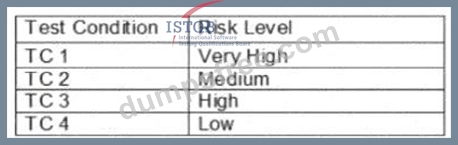
Traceability matrix
Which one of the following is a correct statement regarding the current status of test plan objectives?
SELECT ONE OPTION
- A. None of the objectives have been met.
- B. All the Traceability objective has been met.
- C. All objectives have been met.
- D. Only Approach and Traceability objectives have been met.
Answer: B
NEW QUESTION # 16
What is the purpose of process improvement assessment models?
- A. Model the failure modes of the product
- B. Identify the test tools needed for testing
- C. Assist in the hiring of new testers
- D. Ensure a consistent approach is used
Answer: D
Explanation:
Process improvement assessment models are designed to ensure a consistent approach is used in evaluating and improving processes within an organization. They provide a structured framework for assessing the current state of processes, identifying areas for improvement, and implementing changes in a systematic manner.
References: The purpose of process improvement assessment models is outlined in ISTQB documentation, which emphasizes the importance of a consistent and structured approach to process improvement1. For detailed references, please consult the official ISTQB Advanced Level Test Manager documents and study guides available on the ISTQB website.
NEW QUESTION # 17
You are the Test Manager on a new project. The schedule is aggressive and will require the team to work at peak efficiency. The requirements are not well defined yet, but it is clear that the project will be using new technologies. To help the developers meet the development schedule, an offshore group will be added to the development team.
At this time there is not enough budget to add more testing resources. The project stakeholders are very concerned about the quality of delivered product and will be watching the project closely, particularly during the testing cycles. The exit criteria from the system test level require no open high priority
/severity defects, 100% pass rate for all test cases covering risks that are classified as
"high" or "very high", 90% pass rate for all "medium" risks and 50% pass rate for all "low" and "very low" risks.
Given this information, which lifecycle model should you recommend? [3]
- A. Iterative/incremental
- B. Spiral
- C. V-model
- D. Waterfall
Answer: A
Explanation:
An iterative/incremental lifecycle model is a type of software development lifecycle that divides the project into smaller iterations or increments, each delivering a part of the functionality and undergoing its own planning, analysis, design, implementation, and testing phases1. This model is suitable for projects that have aggressive schedules, unclear requirements, new technologies, distributed teams, and high quality expectations, as it allows for early feedback, risk reduction, parallel development, frequent delivery, and continuous improvement2. Therefore, option B is the correct answer. Option A is incorrect because a spiral model is a type of iterative/incremental model that adds risk analysis and prototyping activities to each iteration3. While this model can also handle unclear requirements, new technologies, and high quality expectations, it may not be the best choice for projects that have aggressive schedules and distributed teams, as it requires more time and communication for risk assessment and prototyping4. Option C is incorrect because a V-model is a type of sequential model that maps each development phase to a corresponding testing phase in a V-shaped diagram5. This model is suitable for projects that have clear and stable requirements, well-known technologies, co-located teams, and moderate quality expectations, as it allows for early verification, traceability, and defect prevention. However, this model may not be the best choice for projects that have aggressive schedules, unclear requirements, new technologies, distributed teams, and high quality expectations, as it does not allow for early feedback, risk reduction, parallel development, frequent delivery, and continuous improvement. Option D is incorrect because a waterfall model is a type of sequential model that follows a linear sequence of phases from requirements to deployment. This model is suitable for projects that have simple and fixed requirements, well-known technologies, co-located teams, and low quality expectations, as it allows for easy planning, management, and documentation. However, this model may not be the best choice for projects that have aggressive schedules, unclear requirements, new technologies, distributed teams, and high quality expectations, as it does not allow for early feedback, risk reduction, parallel development, frequent delivery, and continuous improvement. References: 1: ISTQB Glossary, Iterative/incremental lifecycle model 2: ISTQB Advanced Level Test Manager Syllabus, Section 1.2.1 3:
ISTQB Glossary, Spiral model 4: ISTQB Advanced Level Test Manager Syllabus, Section 1.2.1 5: ISTQB Glossary, V-model : ISTQB Advanced Level Test Manager Syllabus, Section 1.2.1 : ISTQB Advanced Level Test Manager Syllabus, Section 1.2.1 : ISTQB Glossary, Waterfall model : ISTQB Advanced Level Test Manager Syllabus, Section 1.2.1 : ISTQB Advanced Level Test Manager Syllabus, Section 1.2.1
NEW QUESTION # 18
You are a test team lead working on a large project and have been subject to considerable stress due to exceptional workload. Your manager has suggested that you need to delegate more work to your team members to both reduce the pressure on yourself and allow team members to take on more responsibility which would, in turn, benefit their growth. Which phase of the Tuckman model would this situational skill represent?
- A. Storming
- B. Norming
- C. Performing
- D. Forming
Answer: C
Explanation:
The "Performing" stage in the Tuckman model is characterized by high-performing teams that are well- organized, motivated, and able to manage and delegate responsibilities effectively. Delegation and enabling team member growth are signs of a mature and performing team. This corresponds to fostering autonomy and productivity, a key trait of the Performing stage.
Reference: Though not named explicitly in the syllabus, the Tuckman model is generally accepted in team dynamics and is a valid topic under leadership responsibilities of a test manager in ISTQB Advanced Test Manager context.
NEW QUESTION # 19
Which of the Mowing should be used to understand the context of testing within an organization?
- A. The organizational test strategy
- B. The schedule
- C. Stakeholder organization chart
- D. The budget
Answer: A
Explanation:
Context Analysis:
The test strategy defines th Context Analysis:
Monitoring code coverage is inherently tied to knowledge of the internal structure of the software, a characteristic of white-box testing.
Evaluation of Options:
A . Black-box:
Incorrect. Black-box testing focuses on functionality without knowledge of internal structures.
B . White-box:
Correct. White-box testing uses internal code knowledge to determine areas that need more coverage.
C . Functional:
Incorrect. Functional testing assesses functionality without inspecting internal code.
D . Non-functional:
Incorrect. Non-functional testing focuses on performance, usability, etc., not code coverage.
Syllabus Alignment:
ISTQB associates code coverage monitoring with white-box testing techniques (TM-1.2.6).
Reference:
ISTQB Advanced Level Test Management Syllabus (TM-1.2.6)
approach, resources, and processes for testing within an organization. It provides insight into the testing context.
Evaluation of Options:
A . The organizational test strategy:
Correct. It offers a comprehensive understanding of the organization's testing framework.
B . Stakeholder organization chart:
Incorrect. Useful for identifying roles but does not provide a testing context.
C . The schedule:
Incorrect. Reflects timelines but not testing approaches or resources.
D . The budget:
Incorrect. Indicates financial constraints but not the testing context.
Syllabus Alignment:
ISTQB emphasizes using the organizational test strategy to understand the testing context (TM-1.4.1).
ISTQB Advanced Level Test Management Syllabus (TM-1.4.1)
NEW QUESTION # 20
What is the purpose of tracking efficiency metrics for a formal review? [1]
- A. These metrics can be used to determine who participated in the review.
- B. These metrics can be used to determine if the review was a good use of resources.
- C. These metrics can be used to determine the quality of the reviewed object.
- D. These metrics can be used to determine the speed with which defects were fixed.
Answer: B
Explanation:
Efficiency metrics for a formal review are used to measure the cost-effectiveness of the review process, such as the time spent on the review, the number of defects found, and the return on investment1. These metrics can help to evaluate if the review was a good use of resources, such as human effort, money, and tools. Therefore, option B is the correct answer. Option A is incorrect because efficiency metrics do not track who participated in the review, but rather how they performed. Option C is incorrect because efficiency metrics do not measure the quality of the reviewed object, but rather the quality of the review process. Option D is incorrect because efficiency metrics do not measure the speed with which defects were fixed, but rather the speed with which defects were detected. References: 1: How to manage formal reviews & management audits? Skills, metrics ...
NEW QUESTION # 21
The development manager is managing the review of the responses received from bidders, and has asked the in-house test manager to provide a review checklist for the test management aspects of the responses. Which of the following checkpoints would be appropriate? 2 credits
- A. The bidder's project strategy shows that the data content of all the test environments conforms to EU standards.
- B. The bidder's test plan shows that the application will be delivered for acceptance in six months time.
- C. The bidder's project test plan depicts a phased implementation with later delivery dates to be confirmed and states that test deliverables will be developed using IEEE 829 as a guide.
- D. The bidder's test policy should enforce that incident management fully conforms to IEEE 1044.
Answer: C
Explanation:
Explanation/Reference:
Explanation:
NEW QUESTION # 22
Which of the following is a key characteristic of a management review? [1]
- A. Run by a moderator
- B. Used to check consistency of and deviation from the system requirements
- C. Used to assess project risks
- D. Conducted by an external group to assess process compliance
Answer: D
Explanation:
A management review, particularly in the context of software testing and quality assurance, often involves an external group or higher-level management team that reviews the processes and procedures to ensure compliance with specified standards or objectives. This can include assessing the effectiveness of current practices, identifying areas for improvement, and ensuring that the project aligns with organizational or industry standards. This type of review is distinct from other forms of reviews like technical reviews or walkthroughs, which might focus more on the technical aspects or consistency of system requirements.
NEW QUESTION # 23
You have just conducted a skills assessment for your team. You decided to rate everyone from 1 to 5 in the skill areas as follows:
5 = expert
4 = proficient
3 = can use this skill effectively but will need some assistance
2 = interested in learning this skill but has only minimal knowledge
1 = not interested in learning this skill
Given these values, you have rated your team as shown in the table below for the designated skill areas: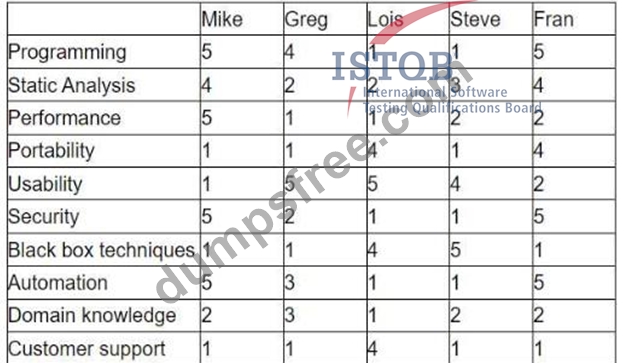
You will be starting to test a new product that is an upgrade from one of your existing end user products. Your testing will include white box, performance, security, usability, and black box. You also have a goal to automate 100% of the smoke test and 50% of the regression tests by the end of the release.
Your team willingly shares knowledge and conducts regular lunch time cross-training sessions.
Your manager wants to know if you would like to bring in someone to help train your team in preparation for this project. In which area could you best utilize this help? [3]
- A. Training in domain knowledge
- B. Training in automation
- C. Training in customer support
- D. Training in black box techniques
Answer: B
Explanation:
Based on the table, the area where your team could best utilize help is training in automation. This is because most of your team members are either not interested in learning this skill or have only minimal knowledge about it. Automation is an important skill for testing, especially for achieving your goal of automating the smoke test and the regression test. Training in automation can help your team to learn how to use various tools and frameworks to create, execute, and maintain automated test scripts. Training in automation can also improve the efficiency, effectiveness, and coverage of your testing process. Best Automation Courses & Certificates OnlineTraining - ISATop Automation Courses Online Reference:
Best Automation Courses & Certificates Online
Training - ISA
Top Automation Courses Online
NEW QUESTION # 24
Continuing with the Scenario described in the previous question, which of the following topics would you need to address in detail in the master test plan? 3 credits
- A. A description of dependencies between test cases
- B. A logical collection of test cases
- C. A list of boundary values for "advance amount"
- D. An approach to regression testing
Answer: D
Explanation:
Explanation/Reference:
Explanation:
NEW QUESTION # 25
You plan to introduce a new tester to your Agile team who has expertise in test automation, a necessary skill lacking in current team members. The individual has a high degree of technical competence but has only ever worked alone and admits to finding face-to-face communication difficult.
What would be the BEST course of action?
- A. Provide them with details of an online self-study program covering communication skills
- B. Do not use this person. Face-to-face communication is essential in Agile and they will only prove disruptive
- C. Peer learning and sharing occurs naturally in Agile teams, so there is no need for any training
- D. Send them on an external training course covering communications skills and connect them with an experienced mentor
Answer: D
Explanation:
The ISTQB syllabus encourages the development of social and interpersonal competencies including communication and teamwork, especially in Agile environments. A tester in an Agile team must collaborate effectively. Therefore, supporting a technically competent tester with targeted communication training and mentorship is the optimal development approach.
NEW QUESTION # 26
Which of the following is required to apply an experience-based testing approach''
- A. Tester knowledge of the system and its usage
- B. A full risk-assessment to support risk prioritization
- C. Usage models
- D. Detailed requirements
Answer: A
Explanation:
Experience-Based Testing:
This testing approach relies on the testers' knowledge, experience, and intuition about the system and its usage rather than formal requirements or models.
It is often used when documentation is incomplete or time constraints limit more structured approaches.
Evaluation of Options:
A (Detailed requirements) and B (Usage models) are associated with structured testing techniques.
C is correct as experience-based testing depends on the testers' understanding of the system.
D (Full risk assessment) supports risk-based testing, not experience-based testing.
Reference and Syllabus Alignment:
Experience-based testing is detailed under "Test Techniques" (TM-1.4.1) in the ISTQB syllabus.
NEW QUESTION # 27
Which of the following is least likely to be used as a technique to identify project and product risks? 1 credit
- A. Inspections
- B. Expert interviews
- C. Independent assessments
- D. Brainstorming
Answer: A
Explanation:
Explanation/Reference:
Explanation:
NEW QUESTION # 28
You are assigned to test a new application being developed in-house and you have designed a set of test cases to specifically address key product risks. You will issue daily reports summarising how these test cases are progressing during test execution. When considering the audience for these reports, in which stakeholder matrix quadrant would the product's users reside?
- A. Apathetic (Low Influence, Low Interest)
- B. Promoters (High Influence, High Interest)
- C. Defenders (Low Influence, High Interest)
- D. Latents (High Influence, Low Interest)
Answer: C
Explanation:
In stakeholder matrix categorization,Defendersare stakeholders who havelow influencebuthigh interest. End users usually have a strong interest in how the product performs, but less influence on project decisions.
"Stakeholders with high interest but low influence are likely to be end-users who rely on timely and accurate information." (Source: ISTQB Advanced Level Test Manager Syllabus 2012, Section 1.4.1) Thus,Option Bis correct.
NEW QUESTION # 29
You are the Test Manager on a new project. The schedule is aggressive and will require the team to work at peak efficiency. The requirements are not well defined yet, but it is clear that the project will be using new technologies. To help the developers meet the development schedule, an offshore group will be added to the development team.
At this time there is not enough budget to add more testing resources. The project stakeholders are very concerned about the quality of the delivered product and will be watching the project closely, particularly during the testing cycles. The exit criteria from the system test level require no open high priority/severity defects, 100% pass rate for all test cases covering risks that are classified as "high" or "very high", 95% pass rate for all "medium" risks and 75% pass rate for all "low" and "very low" risks.
Given this information, which of the activities of the standard test process are the most critical for the Test Manager to perform? [3]
- A. Test monitoring and control
- B. Test execution
- C. Project management, particularly regarding scheduling and budgeting
- D. Requirements reviews
Answer: A
Explanation:
The most critical activity of the standard test process for the Test Manager to perform in this scenario is test monitoring and control. This is because test monitoring and control involves measuring and evaluating the test progress, quality, and risks, and taking corrective actions when necessary. Given the aggressive schedule, the unclear requirements, the new technologies, the offshore development team, the limited testing resources, and the high stakeholder expectations, the Test Manager needs to closely monitor and control the testing activities to ensure that the test objectives and exit criteria are met, and that any deviations or issues are identified and resolved in a timely manner. Test Monitoring and Control - ISTQB not-for-profit association Reference: Certified Tester Advanced Level Test Manager (CTAL-TM) - ISTQB not-for-profit association, ISTQB Test Manager Certification - ISTQB Exams Worldwide - ISTQB Official Registration, Test Monitoring and Control - ISTQB not-for-profit association
NEW QUESTION # 30
If you are monitoring code coverage during testing to determine what areas still need testing what type of testing is likely occurring?
- A. White-box
- B. Black-box
- C. Functional
- D. Non-functional
Answer: A
Explanation:
Context Analysis:
Monitoring code coverage is inherently tied to knowledge of the internal structure of the software, a characteristic of white-box testing.
Evaluation of Options:
A . Black-box:
Incorrect. Black-box testing focuses on functionality without knowledge of internal structures.
B . White-box:
Correct. White-box testing uses internal code knowledge to determine areas that need more coverage.
C . Functional:
Incorrect. Functional testing assesses functionality without inspecting internal code.
D . Non-functional:
Incorrect. Non-functional testing focuses on performance, usability, etc., not code coverage.
Syllabus Alignment:
ISTQB associates code coverage monitoring with white-box testing techniques (TM-1.2.6).
Reference:
ISTQB Advanced Level Test Management Syllabus (TM-1.2.6)
NEW QUESTION # 31
......
CTAL-TM-001 Dumps Full Questions with Free PDF Questions to Pass: https://dumpstorrent.dumpsfree.com/CTAL-TM-001-valid-exam.html