


Latest [Dec 19, 2025] 1z1-809 Exam Dumps - Valid and Updated Dumps
Free Sales Ending Soon - 100% Valid 1z1-809 Exam Dumps with 209 Questions
NEW QUESTION # 49
Given the code fragment:
What is the result?
Word: why what when
- A. Word: why Word: what Word: when
- B.
- C. Compilation fails at line n1.
- D. Word: why Word: why what Word: why what when
Answer: D
NEW QUESTION # 50
Given: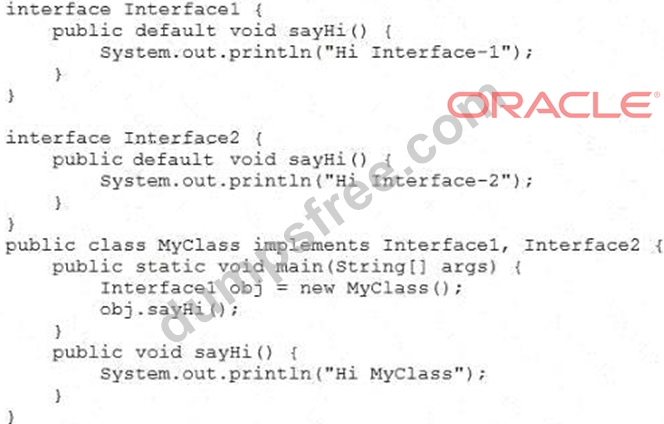
What is the result?
- A. Hi Interface-1
- B. Hi Interface-2
- C. Hi MyClass
- D. A compilation error occurs.
Answer: C
NEW QUESTION # 51
Given the code fragment:
List<String> listVal = Arrays.asList("Joe", "Paul", "Alice", "Tom");
System.out.println (
// line n1
);
Which code fragment, when inserted at line n1, enables the code to print the count of string elements whose length is greater than three?
- A. listVal.stream().filter(x -> x.length()>3).mapToInt(x -> x).count()
- B. listVal.stream().filter(x -> x.length()>3).count()
- C. listVal.stream().peek(x -> x.length()>3).count().get()
- D. listVal.stream().map(x -> x.length()>3).count()
Answer: C
NEW QUESTION # 52
Given the code fragment:
What is the result?
- A. Hi removed
- B. An UnsupportedOperationException is thrown at runtime.
- C. Compilation fails.
- D. The program compiles, but it prints nothing.
Answer: C
NEW QUESTION # 53
Given the Greetings.propertiesfile, containing:
and given: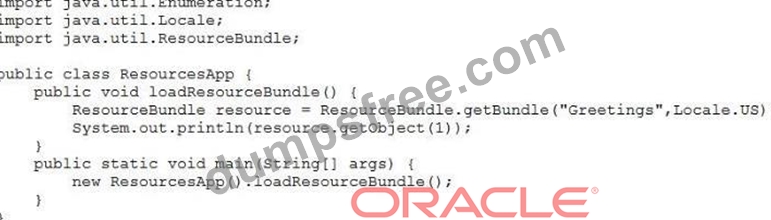
What is the result?
- A. HELLO_MSG
- B. Compilation fails.
- C. Goodbye everyone!
- D. Hello, everyone!
- E. GOODBY_MSG
Answer: B
NEW QUESTION # 54
Given the definition of the Employee class: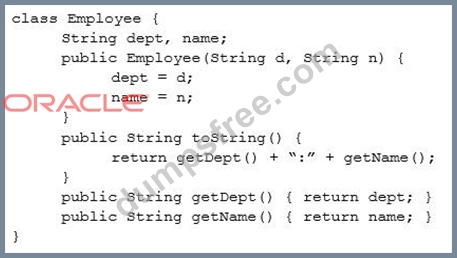
and this code fragment: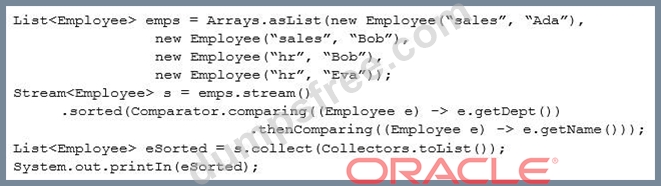
What is the result?
- A. [hr:Bob, hr:Eva, sales:Ada, sales:Bob]
- B. [Ada:sales, Bob:sales, Bob:hr, Eva:hr]
- C. [sales:Ada, hr:Bob, sales:Bob, hr:Eva]
- D. [hr:Eva, hr:Bob, sales:Bob, sales:Ada]
Answer: C
NEW QUESTION # 55
public class ForTest {
public static void main(String[] args) {
int[] arrar = {1,2,3};
for ( foo ) {
}
}
}
Which three are valid replacements for foo so that the program will compiled and run?
- A. int i: array
- B. ; i < 1;
- C. ; i < 1; i++
- D. int i = 0; i < 1; i++
- E. ;;
Answer: A,D,E
NEW QUESTION # 56
Given:
class Book {
int id;
String name;
public Book (int id, String name) {
this.id = id;
this.name = name;
}
public boolean equals (Object obj) { //line n1
boolean output = false;
Book b = (Book) obj;
if (this.name.equals(b name))}
output = true;
}
return output;
}
}
and the code fragment:
Book b1 = new Book (101, "Java Programing");
Book b2 = new Book (102, "Java Programing");
System.out.println (b1.equals(b2)); //line n2
Which statement is true?
- A. A compilation error occurs. To ensure successful compilation, replace line n1with:
boolean equals (Book obj) { - B. The program prints false.
- C. The program prints true.
- D. A compilation error occurs. To ensure successful compilation, replace line n2with:
System.out.println (b1.equals((Object) b2));
Answer: C
NEW QUESTION # 57
Given the code fragment:
Which code fragment, when inserted at line n1, ensures false is printed?
- A. boolean b = cs.stream() .findAny() .get() .equals("Java");
- B. boolean b = cs.stream() .findFirst() .get() .equals("Java");
- C. boolean b = cs.stream() .anyMatch (w -> w.equals ("Java"));
- D. boolean b = cs.stream() .allMatch(w -> w.equals("Java"));
Answer: C
NEW QUESTION # 58
Given the definition of the Country class:
public class country {
public enum Continent {ASIA, EUROPE}
String name;
Continent region;
public Country (String na, Continent reg) {
name = na, region = reg;
}
public String getName () {return name;}
public Continent getRegion () {return region;}
}
and the code fragment:
List<Country> couList = Arrays.asList (
new Country ("Japan", Country.Continent.ASIA),
new Country ("Italy", Country.Continent.EUROPE),
new Country ("Germany", Country.Continent.EUROPE));
Map<Country.Continent, List<String>> regionNames = couList.stream ()
.collect(Collectors.groupingBy (Country ::getRegion,
Collectors.mapping(Country::getName, Collectors.toList()))));
System.out.println(regionNames);
- A. {ASIA = [Japan], EUROPE = [Italy, Germany]}
- B. {EUROPE = [Germany], EUROPE = [Italy], ASIA = [Japan]}
- C. {EUROPE = [Italy, Germany], ASIA = [Japan]}
- D. {EUROPE = [Germany, Italy], ASIA = [Japan]}
Answer: C
NEW QUESTION # 59
Given the code fragment:
public class Foo {
public static void main (String [ ] args) {
Map<Integer, String> unsortMap = new HashMap< > ( );
unsortMap.put (10, "z");
unsortMap.put (5, "b");
unsortMap.put (1, "d");
unsortMap.put (7, "e");
unsortMap.put (50, "j");
Map<Integer, String> treeMap = new TreeMap <Integer, String> (new
Comparator<Integer> ( ) {
@ Override public int compare (Integer o1, Integer o2) {return o2.compareTo ( o1); } } );
treeMap.putAll (unsortMap);
for (Map.Entry<Integer, String> entry : treeMap.entrySet () ) {
System.out.print (entry.getValue () + " ");
}
}
}
What is the result?
- A. d b e z j
- B. A compilation error occurs.
- C. z b d e j
- D. j z e b d
Answer: D
NEW QUESTION # 60
Given the code fragment:
Which code fragment, when inserted at line n1, ensures false is printed?
- A. boolean b = cs.stream() .findAny() .get() .equals("Java");
- B. boolean b = cs.stream() .findFirst() .get() .equals("Java");
- C. boolean b = cs.stream() .anyMatch (w -> w.equals ("Java"));
- D. boolean b = cs.stream() .allMatch(w -> w.equals("Java"));
Answer: C
NEW QUESTION # 61
Assume customers.txt is accessible and contains multiple lines.
Which code fragment prints the contents of the customers.txt file?
- A. Stream<Path> stream = Files.list (Paths.get ("customers.txt")); stream.forEach( c) -> System.out.println(c));
- B. Stream<Path> stream = Files.find (Paths.get ("customers.txt")); stream.forEach( c) -> System.out.println(c));
- C. Stream<String> stream = Files.find (Paths.get ("customers.txt")); stream.forEach((String c) -> System.out.println(c));
- D. Stream<String> lines = Files.lines (Paths.get ("customers.txt")); lines.forEach( c) -> System.out.println(c));
Answer: C
NEW QUESTION # 62
Which class definition compiles?
- A. public class ProductCode {
private String code;
public ProductCode(String code) {
if (code == null) {
throw new IllegalArgumentException("Code cannot be null");
}
this.code = code;
}
} - B. public class ProductCode {
private String code;
private ProductCode(String code) {
this.code = code;
}
}
C.
public class ProductCode {
private String code;
public ProductCode() {
this.code = "default";
}
} - C. public class ProductCode {
private String code;
public ProductCode(String code) {
this.code = code;
}
}
Answer: B
NEW QUESTION # 63
Given the code fragment:
Which modification enables the code to print Price 5 New Price 4?
- A. Replace line n3 with .forEach (n -> System.out.println ("New Price" + n));
- B. Replace line n2 with .map (n -> System.out.println ("New Price" + n -1)) and remove line n3
- C. Replace line n2 with .mapToInt (n -> n - 1);
- D. Replace line n1 with .forEach (e -> System.out.print ("Price" + e))
Answer: A
NEW QUESTION # 64
Given:
class Student {
String course, name, city;
public Student (String name, String course, String city) {
this.course = course; this.name = name; this.city = city;
}
public String toString() {
return course + ":" + name + ":" + city;
}
and the code fragment:
List<Student> stds = Arrays.asList(
new Student ("Jessy", "Java ME", "Chicago"),
new Student ("Helen", "Java EE", "Houston"),
new Student ("Mark", "Java ME", "Chicago"));
stds.stream()
.collect(Collectors.groupingBy(Student::getCourse))
.forEach(src, res) -> System.out.println(scr));
What is the result?
- A. [Java EE: Helen:Houston]
[Java ME: Jessy:Chicago, Java ME: Mark:Chicago] - B. Java EE
Java ME - C. [Java ME: Jessy:Chicago, Java ME: Mark:Chicago] [Java EE: Helen:Houston]
- D. A compilation error occurs.
Answer: B
NEW QUESTION # 65
Given the code fragment: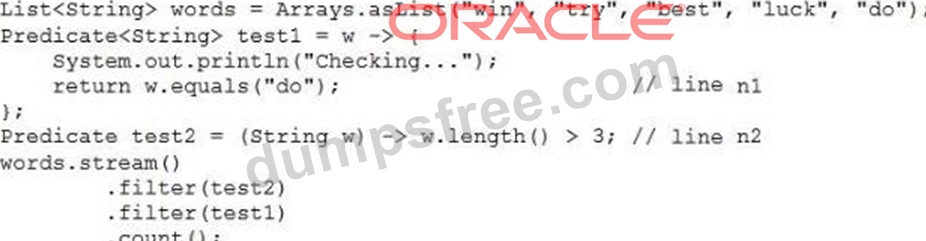
What is the result?
- A. Checking...
Checking... - B. A compilation error occurs at line n2.
- C. Checking...
- D. A compilation error occurs at line n1.
Answer: D
NEW QUESTION # 66
Given the code fragment: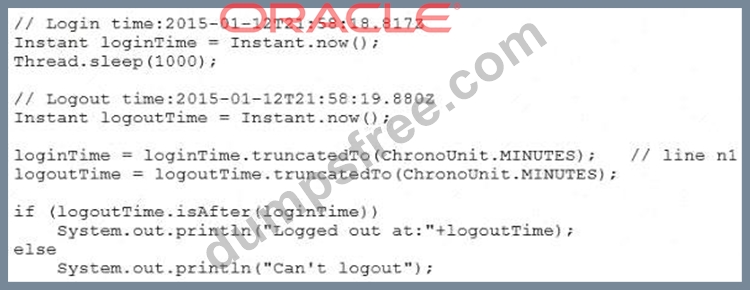
What is the result?
- A. A compilation error occurs at line n1.
- B. Can't logout
- C. Logged out at: 2015-01-12T21:58:19.880Z
- D. Logged out at: 2015-01-12T21:58:00Z
Answer: D
NEW QUESTION # 67
Given:
class Bird {
public void fly () { System.out.print("Can fly"); }
}
class Penguin extends Bird {
public void fly () { System.out.print("Cannot fly"); }
}
and the code fragment:
class Birdie {
public static void main (String [ ] args) {
fly( ( ) -> new Bird ( ));
fly (Penguin : : new);
}
/* line n1 */
}
Which code fragment, when inserted at line n1, enables the Birdie class to compile?
- A. static void fly (Consumer<? extends Bird> bird) {
bird.accept( ) fly ();
} - B. static void fly (Supplier<? extends Bird> bird) {
LOST - C. static void fly (Consumer<Bird> bird) {
bird :: fly ();
} - D. static void fly (Supplier<Bird> bird) {
bird.get( ) fly ();
}
Answer: D
NEW QUESTION # 68
......
1z1-809 Exam Dumps - 100% Marks In 1z1-809 Exam: https://dumpstorrent.dumpsfree.com/1z1-809-valid-exam.html