


DP-300 Certification – Valid Exam Dumps Questions Study Guide! (Updated 464 Questions)
DP-300 Dumps are Available for Instant Access using DumpsFree
To prepare for the Microsoft DP-300 certification exam, candidates can take advantage of various training resources offered by Microsoft. These resources include online courses, instructor-led training, and study materials such as practice exams and study guides. By investing time and effort in preparation, candidates can increase their chances of passing the exam and earning the Microsoft DP-300 certification.
Microsoft DP-300 exam is a certification designed for database professionals who want to demonstrate their skills in administering relational databases on Microsoft Azure. Administering Relational Databases on Microsoft Azure certification is ideal for IT professionals who are looking to validate their knowledge and expertise in managing and maintaining databases on the Azure platform. The DP-300 exam is a great way to showcase your skills and enhance your career prospects.
NEW QUESTION # 234
You create a new Azure SQL managed instance named SQL1 and enable Database Mail extended stored procedures.
You need to ensure that SOL Server Agent jobs running on SQL 1 can notify administrators when a failure occurs.
Which three actions should you perform in sequence? To answer, move the appropriate actions from the list of actions to the answer area and arrange them in the correct order.
Answer:
Explanation:
Explanation
NEW QUESTION # 235
You manage an enterprise data warehouse in Azure Synapse Analytics.
Users report slow performance when they run commonly used queries. Users do not report performance changes for infrequently used queries.
You need to monitor resource utilization to determine the source of the performance issues.
Which metric should you monitor?
- A. DWU percentage
- B. Cache hit percentage
- C. Local tempdb percentage
- D. Data Warehouse Units (DWU) used
Answer: B
Explanation:
You can use Azure Monitor to view cache metrics to troubleshoot query performance.
The key metrics for troubleshooting the cache are Cache hit percentage and Cache used percentage.
Possible scenario: Your current working data set cannot fit into the cache which causes a low cache hit percentage due to physical reads. Consider scaling up your performance level and rerun your workload to populate the cache.
Reference:
https://docs.microsoft.com/da-dk/azure/synapse-analytics/sql-data-warehouse/sql-data-warehouse-how-to-monitor-cache
NEW QUESTION # 236
You have a new Azure SQL database named DB1 on an Azure SQL server named AzSQL1.
The only user who was created is the server administrator.
You need to create a contained database user in DB1 who will use Azure Active Directory (Azure AD) for authentication.
Which three actions should you perform in sequence? To answer, move the appropriate actions from the list of actions to the answer area and arrange them in the correct order.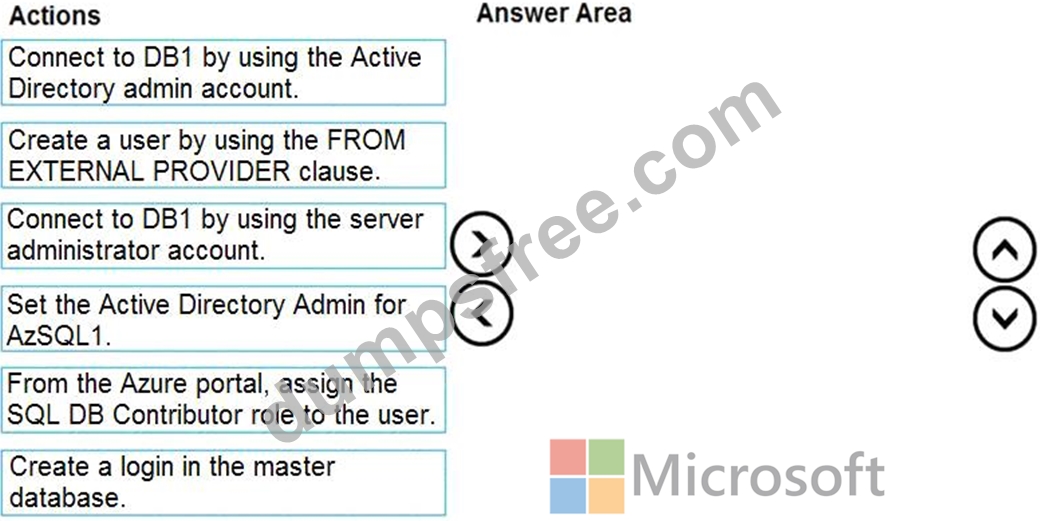
Answer:
Explanation: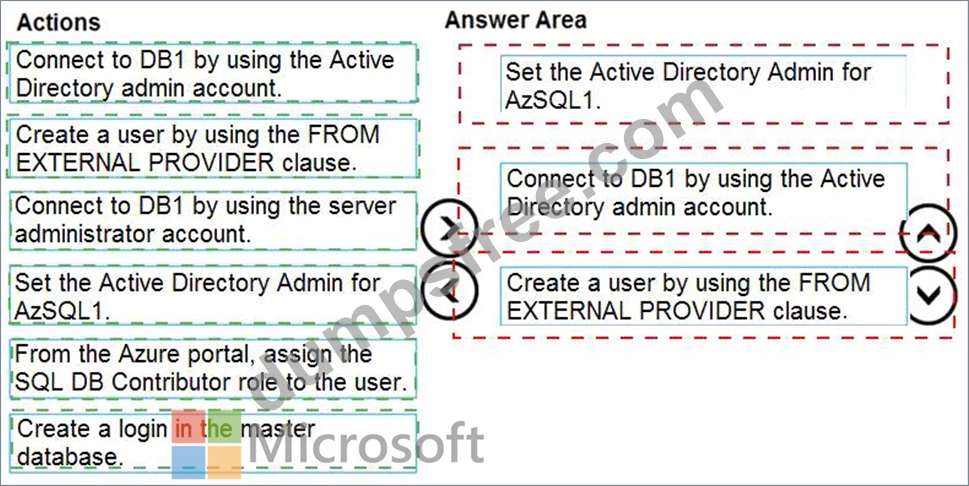
Explanation: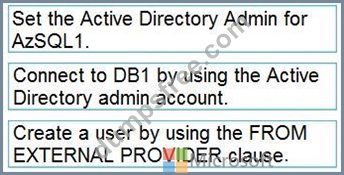
Step 1: Set up the Active Directory Admin for AzSQL1.
Step 2: Connect to DB1 by using the server administrator.
Sign into your managed instance with an Azure AD login granted with the sysadmin role.
Step 3: Create a user by using the FROM EXTERNAL PROVIDER clause.
FROM EXTERNAL PROVIDER is available for creating server-level Azure AD logins in SQL Database managed instance. Azure AD logins allow database-level Azure AD principals to be mapped to server-level Azure AD logins. To create an Azure AD user from an Azure AD login use the following syntax:
CREATE USER [AAD_principal] FROM LOGIN [Azure AD login]
Reference:
https://docs.microsoft.com/en-us/sql/t-sql/statements/create-user-transact-sql
NEW QUESTION # 237
You are evaluating the role assignments.
For each of the following statements, select Yes if the statement is true. Otherwise, select No.
NOTE: Each correct selection is worth one point.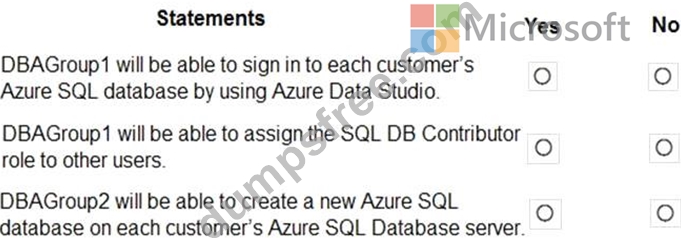
Answer:
Explanation: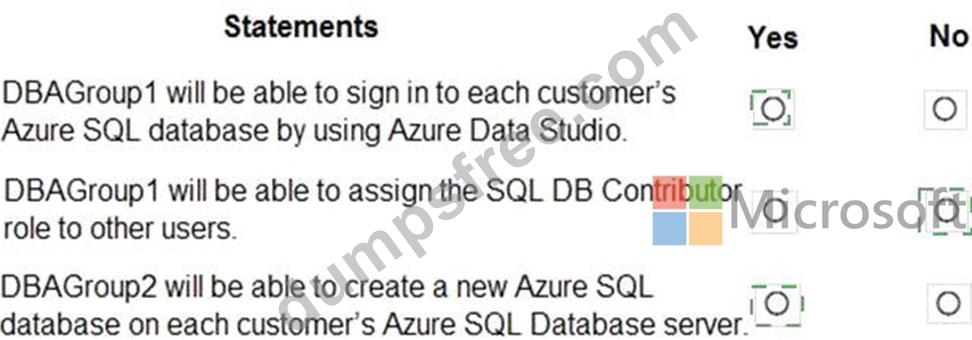
Explanation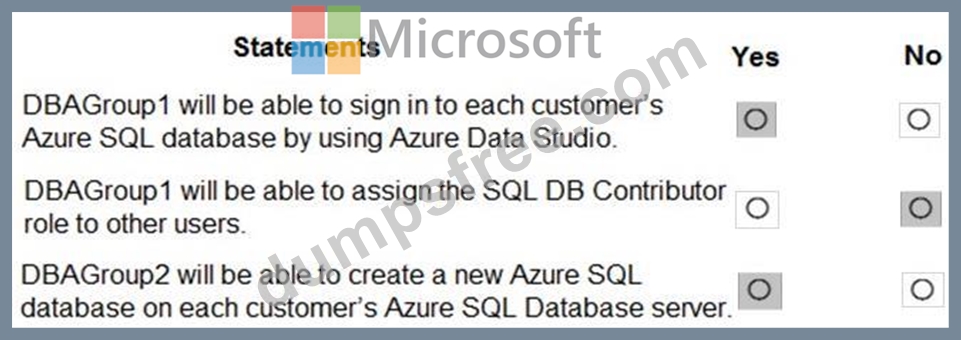
Box 1: Yes
DBAGroup1 is member of the Contributor role.
The Contributor role grants full access to manage all resources, but does not allow you to assign roles in Azure RBAC, manage assignments in Azure Blueprints, or share image galleries.
Box 2: No
Box 3: Yes
DBAGroup2 is member of the SQL DB Contributor role.
The SQL DB Contributor role lets you manage SQL databases, but not access to them. Also, you can't manage their security-related policies or their parent SQL servers. As a member of this role you can create and manage SQL databases.
Reference:
https://docs.microsoft.com/en-us/azure/role-based-access-control/built-in-roles
NEW QUESTION # 238
You are evaluating the role assignments.
For each of the following statements, select Yes if the statement is true. Otherwise, select No.
NOTE: Each correct selection is worth one point.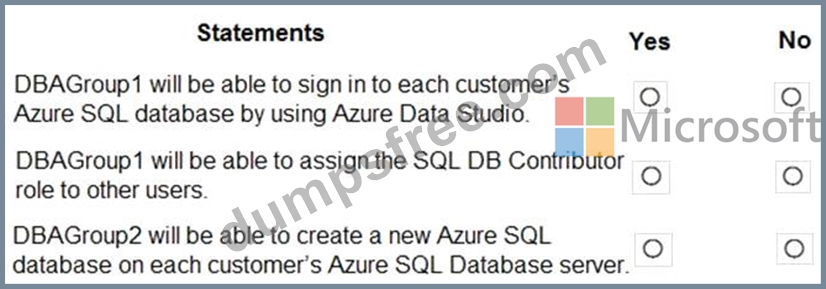
Answer:
Explanation: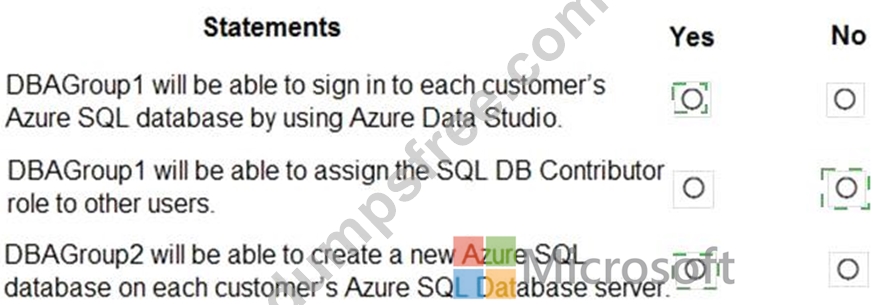
Explanation
Box 1: Yes
DBAGroup1 is member of the Contributor role.
The Contributor role grants full access to manage all resources, but does not allow you to assign roles in Azure RBAC, manage assignments in Azure Blueprints, or share image galleries.
Box 2: No
Box 3: Yes
DBAGroup2 is member of the SQL DB Contributor role.
The SQL DB Contributor role lets you manage SQL databases, but not access to them. Also, you can't manage their security-related policies or their parent SQL servers. As a member of this role you can create and manage SQL databases.
Reference:
https://docs.microsoft.com/en-us/azure/role-based-access-control/built-in-roles
Topic 2, Litware
Existing Environment
Network Environment
The manufacturing and research datacenters connect to the primary datacenter by using a VPN.
The primary datacenter has an ExpressRoute connection that uses both Microsoft peering and private peering.
The private peering connects to an Azure virtual network named HubVNet.
Identity Environment
Litware has a hybrid Azure Active Directory (Azure AD) deployment that uses a domain named litwareinc.com. All Azure subscriptions are associated to the litwareinc.com Azure AD tenant.
Database Environment
The sales department has the following database workload:
* An on-premises named SERVER1 hosts an instance of Microsoft SQL Server 2012 and two 1-TB databases.
* A logical server named SalesSrv01A contains a geo-replicated Azure SQL database named SalesSQLDb1. SalesSQLDb1 is in an elastic pool named SalesSQLDb1Pool. SalesSQLDb1 uses database firewall rules and contained database users.
* An application named SalesSQLDb1App1 uses SalesSQLDb1.
The manufacturing office contains two on-premises SQL Server 2016 servers named SERVER2 and SERVER3. The servers are nodes in the same Always On availability group. The availability group contains a database named ManufacturingSQLDb1 Database administrators have two Azure virtual machines in HubVnet named VM1 and VM2 that run Windows Server 2019 and are used to manage all the Azure databases.
Licensing Agreement
Litware is a Microsoft Volume Licensing customer that has License Mobility through Software Assurance.
Current Problems
SalesSQLDb1 experiences performance issues that are likely due to out-of-date statistics and frequent blocking queries.
Requirements
Planned Changes
Litware plans to implement the following changes:
* Implement 30 new databases in Azure, which will be used by time-sensitive manufacturing apps that have varying usage patterns. Each database will be approximately 20 GB.
* Create a new Azure SQL database named ResearchDB1 on a logical server named ResearchSrv01.
ResearchDB1 will contain Personally Identifiable Information (PII) data.
* Develop an app named ResearchApp1 that will be used by the research department to populate and access ResearchDB1.
* Migrate ManufacturingSQLDb1 to the Azure virtual machine platform.
* Migrate the SERVER1 databases to the Azure SQL Database platform.
Technical Requirements
Litware identifies the following technical requirements:
* Maintenance tasks must be automated.
* The 30 new databases must scale automatically.
* The use of an on-premises infrastructure must be minimized.
* Azure Hybrid Use Benefits must be leveraged for Azure SQL Database deployments.
* All SQL Server and Azure SQL Database metrics related to CPU and storage usage and limits must be analyzed by using Azure built-in functionality.
Security and Compliance Requirements
Litware identifies the following security and compliance requirements:
* Store encryption keys in Azure Key Vault.
* Retain backups of the PII data for two months.
* Encrypt the PII data at rest, in transit, and in use.
* Use the principle of least privilege whenever possible.
* Authenticate database users by using Active Directory credentials.
* Protect Azure SQL Database instances by using database-level firewall rules.
* Ensure that all databases hosted in Azure are accessible from VM1 and VM2 without relying on public endpoints.
Business Requirements
Litware identifies the following business requirements:
* Meet an SLA of 99.99% availability for all Azure deployments.
* Minimize downtime during the migration of the SERVER1 databases.
* Use the Azure Hybrid Use Benefits when migrating workloads to Azure.
* Once all requirements are met, minimize costs whenever possible.
NEW QUESTION # 239
You have two Azure virtual machines named VM1 and VM2 that run Windows Server 2019. VM1 and VM2 each host a default Microsoft SQL Server 2019 instance. VM1 contains a database named DB1 that is backed up to a file named D:\DB1.bak.
You plan to deploy an Always On availability group that will have the following configurations:
VM1 will host the primary replica of DB1.
VM2 will host a secondary replica of DB1.
You need to prepare the secondary database on VM2 for the availability group.
How should you complete the Transact-SQL statement? To answer, select the appropriate options in the answer area.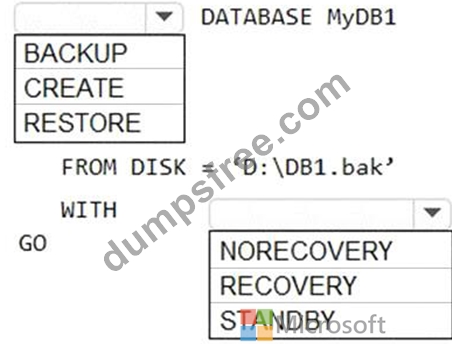
Answer:
Explanation: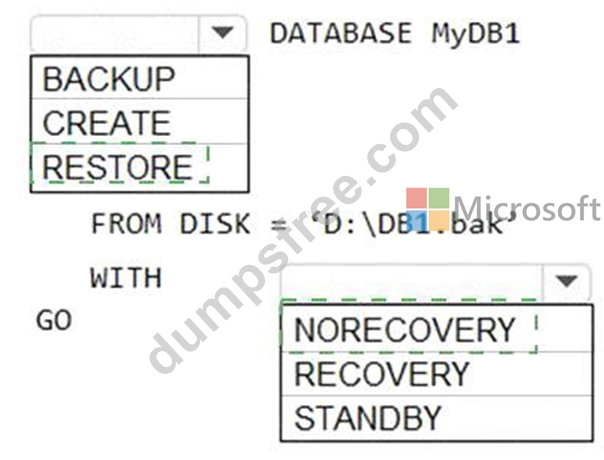
Explanation
Graphical user interface, text, application, chat or text message Description automatically generated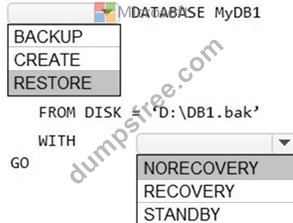
Reference:
https://docs.microsoft.com/en-us/sql/database-engine/availability-groups/windows/manually-prepare-a-secondary
NEW QUESTION # 240
You are designing an anomaly detection solution for streaming data from an Azure IoT hub.
The solution must meet the following requirements:
- Send the output to an Azure Synapse.
- Identify spikes and dips in time series data.
- Minimize development and configuration effort.
Which should you include in the solution?
- A. Azure SQL Database
- B. Azure Databricks
- C. Azure Stream Analytics
Answer: C
Explanation:
Anomalies can be identified by routing data via IoT Hub to a built-in ML model in Azure Stream Analytics Reference:
https://docs.microsoft.com/en-us/learn/modules/data-anomaly-detection-using-azure-iot-hub/
https://docs.microsoft.com/en-us/azure/stream-analytics/azure-synapse-analytics-output
NEW QUESTION # 241
You need to implement the monitoring of SalesSQLDb1. The solution must meet the technical requirements.
How should you collect and stream metrics? To answer, select the appropriate options in the answer area.
NOTE: Each correct selection is worth one point.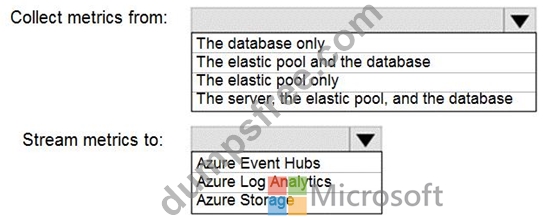
Answer:
Explanation: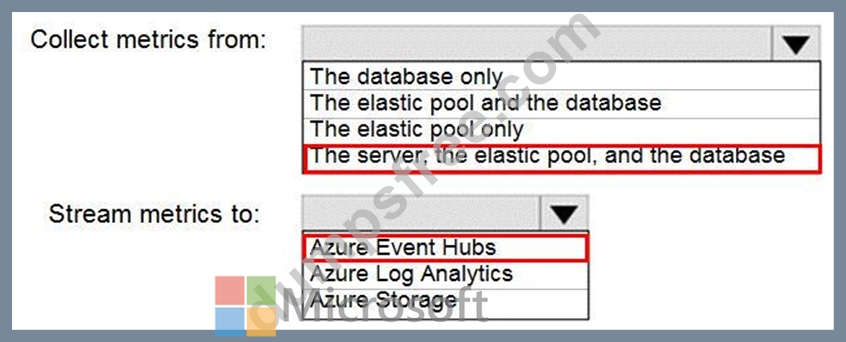
NEW QUESTION # 242
You have a SQL Server on Azure Virtual Machines instance named SQLVM1 that contains two databases named DB1 and DB2. The database and log files for DB1 and DB2 are hosted on managed disks.
You need to perform a snapshot backup of DB1 and DB2
How should you complete the I SQL statements? To answer, select the appropriate options in the answer area.
NOTE: Each correct selection is worth one point.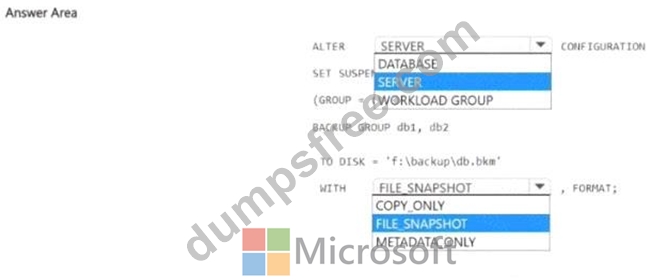
Answer:
Explanation: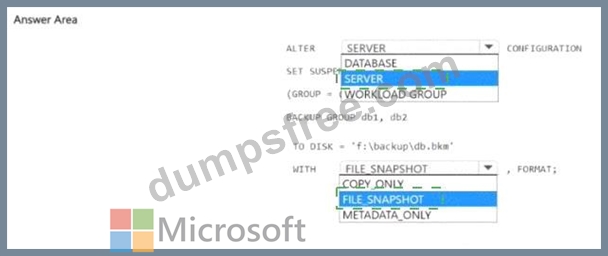
Explanation: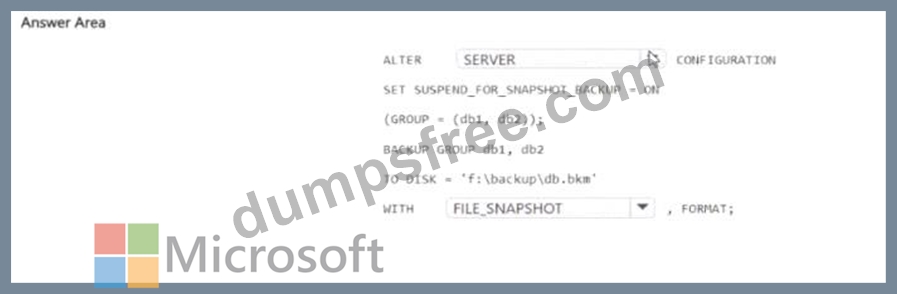
NEW QUESTION # 243
You have an on-premises Microsoft SQL Server 2016 instance that hosts a database named db1. You have an Azure subscription that contains an Azure SQL managed instance named Mil.
You plan to perform an online migration of db1 to MM by using Azure Database Migration Service.
You need to create the backups for the migration. The solution must minimize the number of backup files created.
Which type of backups should you create, and how should you store the backups? To answer, select the appropriate options in the answer area.
NOTE: Each correct selection is worth one point.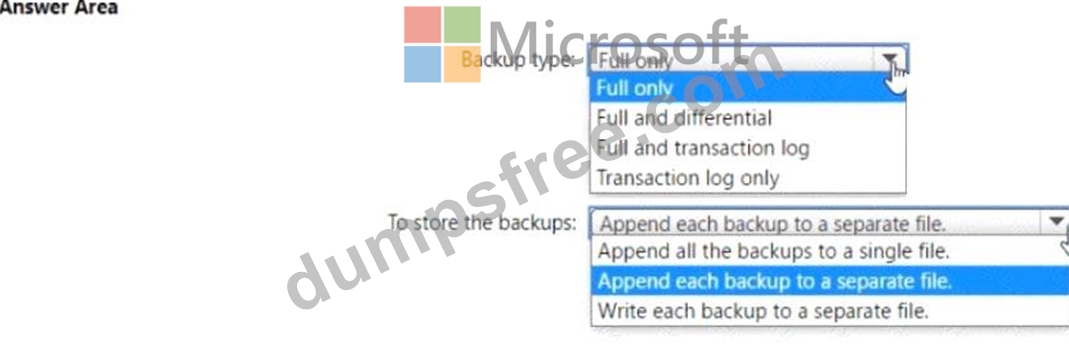
Answer:
Explanation: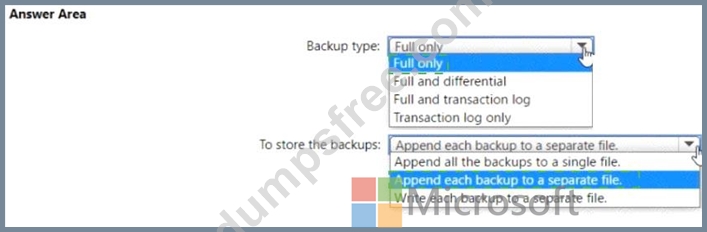
Explanation:
NEW QUESTION # 244
You have an Azure SQL managed instance.
You need to restore a database named DB1 by using Transact-SQL.
Which command should you run? To answer, select the appropriate options in the answer area.
NOTE:Each correct selection is worth one point.
Answer:
Explanation:
Explanation
Text Description automatically generated
NEW QUESTION # 245
You have an Azure SQL database named DB1. The automatic tuning options for DB1 are configured as shown in the following exhibit.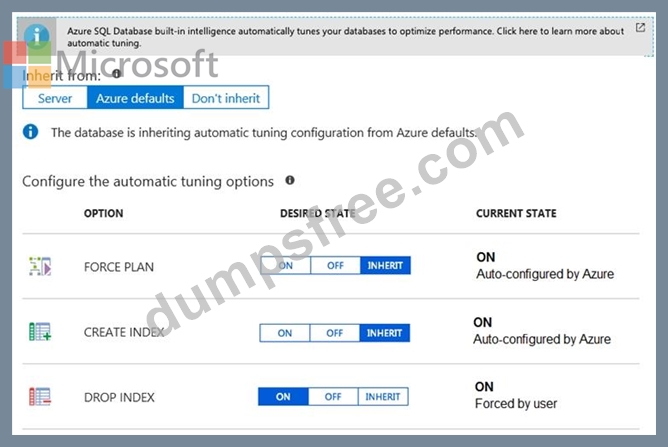
For each of the following statements, select Yes if the statement is true. Otherwise, select No.
NOTE: Each correct selection is worth one point.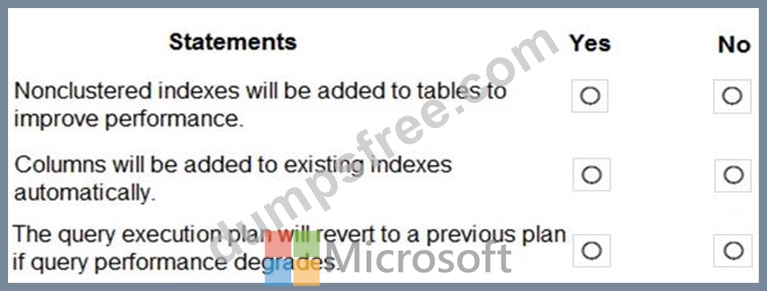
Answer:
Explanation: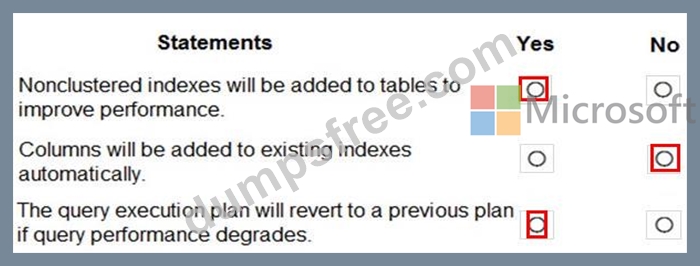
NEW QUESTION # 246
You have an Azure subscription.
You plan to deploy an instance of SQL Server on Azure Virtual Machines that supports Write Accelerator.
Which virtual machine series should you use?
- A. G-series
- B. M-series
- C. H-series
- D. E-series
Answer: B
Explanation:
https://learn.microsoft.com/en-us/azure/virtual-machines/how-to-enable-write-accelerator
NEW QUESTION # 247
HOTSPOT
You are designing an enterprise data warehouse in Azure Synapse Analytics that will store website traffic analytics in a star schema.
You plan to have a fact table for website visits. The table will be approximately 5 GB.
You need to recommend which distribution type and index type to use for the table. The solution must provide the fastest query performance.
What should you recommend? To answer, select the appropriate options in the answer area.
NOTE: Each correct selection is worth one point.
Hot Area: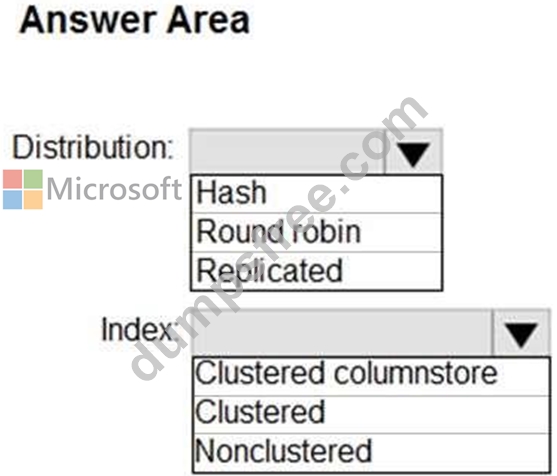
Answer:
Explanation: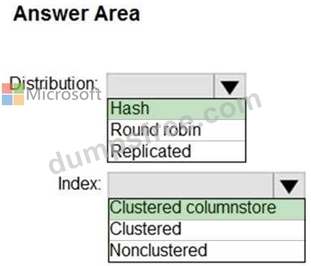
Section: [none]
Explanation:
Box 1: Hash
Consider using a hash-distributed table when:
The table size on disk is more than 2 GB.
The table has frequent insert, update, and delete operations.
Box 2: Clustered columnstore
Clustered columnstore tables offer both the highest level of data compression and the best overall query performance.
Reference:
https://docs.microsoft.com/en-us/azure/synapse-analytics/sql-data-warehouse/sql-data-warehouse-tables- distribute
https://docs.microsoft.com/en-us/azure/synapse-analytics/sql-data-warehouse/sql-data-warehouse-tables-index
NEW QUESTION # 248
You are designing a dimension table in an Azure Synapse Analytics dedicated SQL pool.
You need to create a surrogate key for the table. The solution must provide the fastest query performance.
What should you use for the surrogate key?
- A. an IDENTITY column
- B. a sequence object
- C. a GUID column
Answer: A
Explanation:
Section: [none]
Explanation:
Dedicated SQL pool supports many, but not all, of the table features offered by other databases.
Surrogate keys are not supported. Implement it with an Identity column.
Reference:
https://docs.microsoft.com/en-us/azure/synapse-analytics/sql-data-warehouse/sql-data-warehouse-tables- overview
NEW QUESTION # 249
You are building an Azure Stream Analytics job to retrieve game data.
You need to ensure that the job returns the highest scoring record for each five-minute time interval of each game.
How should you complete the Stream Analytics query? To answer, select the appropriate options in the answer area.
NOTE: Each correct selection is worth one point.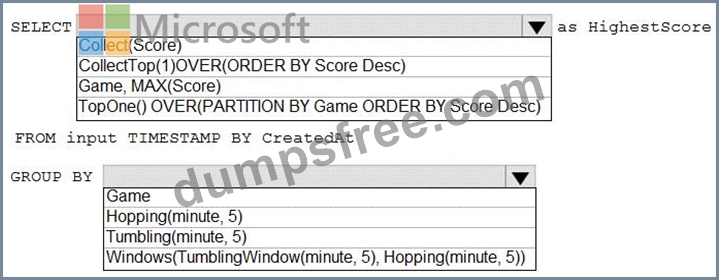
Answer:
Explanation: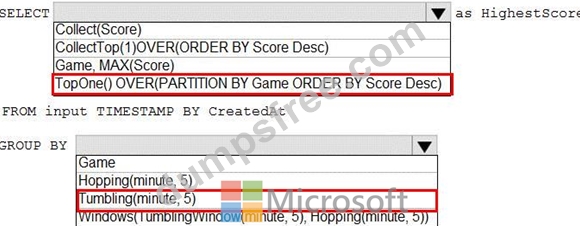
Reference:
https://docs.microsoft.com/en-us/stream-analytics-query/topone-azure-stream-analytics
https://github.com/MicrosoftDocs/azure-docs/blob/master/articles/stream-analytics/stream-analytics-window-functions.md
NEW QUESTION # 250
You have an Azure SQL managed instance.
You need to restore a database named DB1 by using Transact-SQL.
Which command should you run? To answer, select the appropriate options in the answer area.
NOTE: Each correct selection is worth one point.
Answer:
Explanation:
NEW QUESTION # 251
You have an Azure SQL database named DB1 that contains a table named Orders. The Orders table contains a row for each sales order. Each sales order includes the name of the user who placed the order.
You need to implement row-level security (RLS). The solution must ensure that the users can view only their respective sales orders.
What should you include in the solution? To answer, select the appropriate options in the answer area.
NOTE: Each correct selection is worth one point.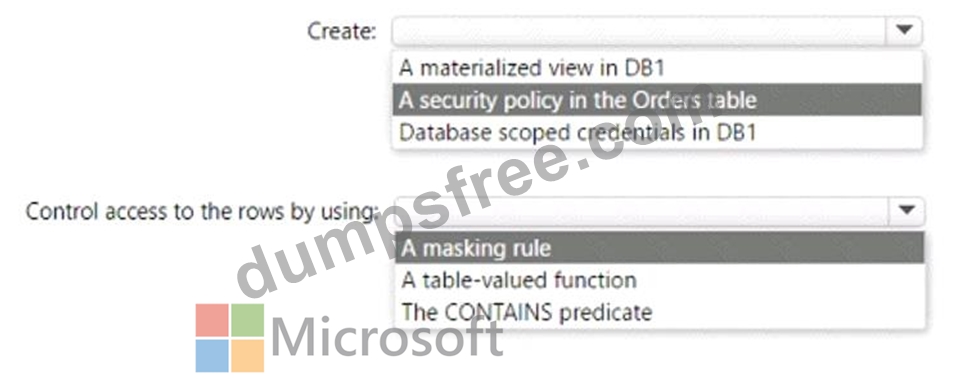
Answer:
Explanation: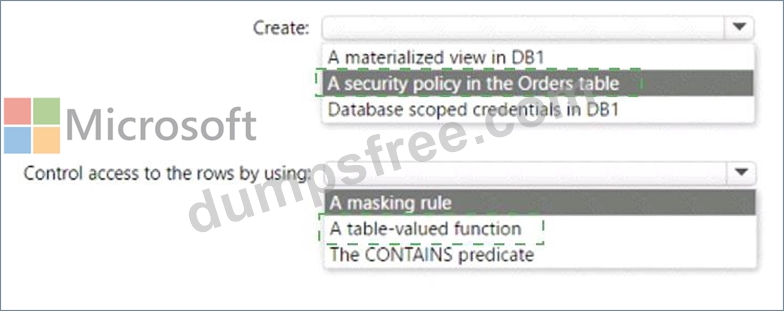
Explanation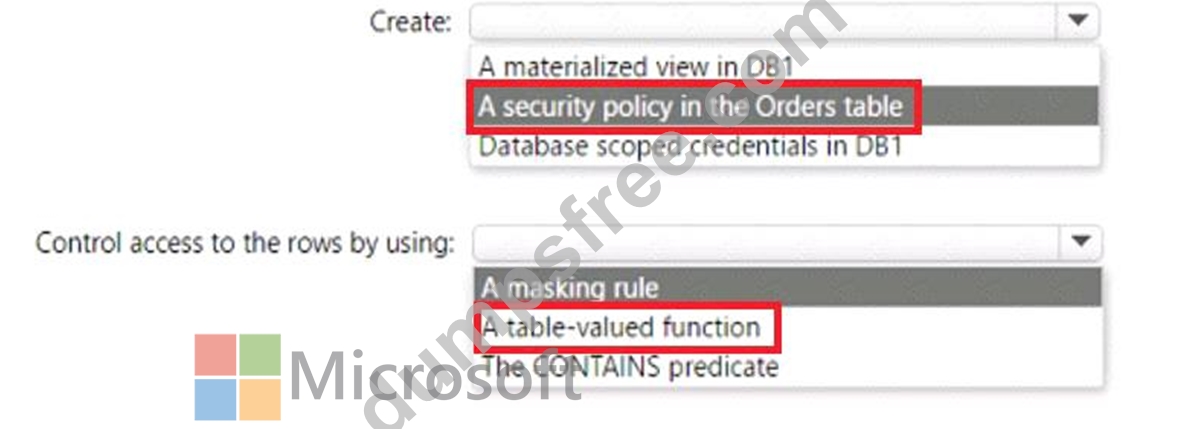
NEW QUESTION # 252
You have SQL Server on an Azure virtual machine that contains a database named DB1.
The database reports a CHECKSUM error.
You need to recover the database.
How should you complete the statements? To answer, select the appropriate options in the answer area.
NOTE: Each correct selection is worth one point.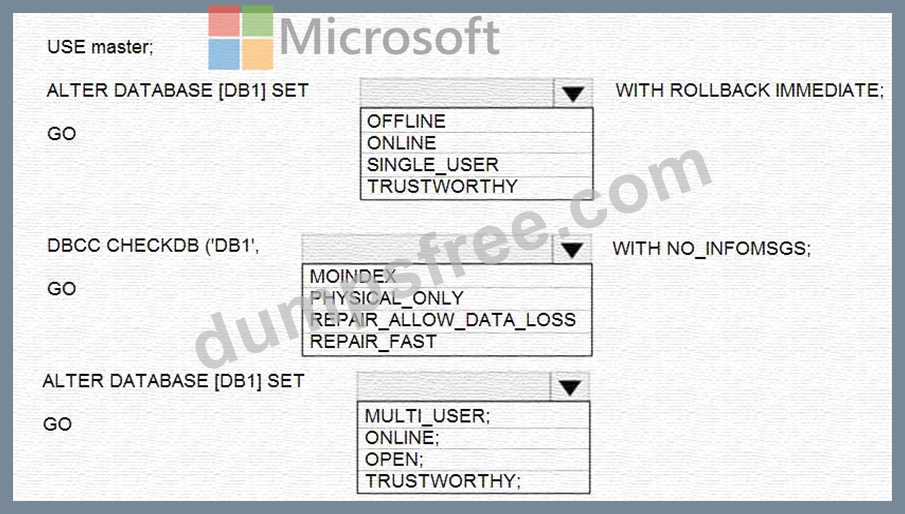
Answer:
Explanation: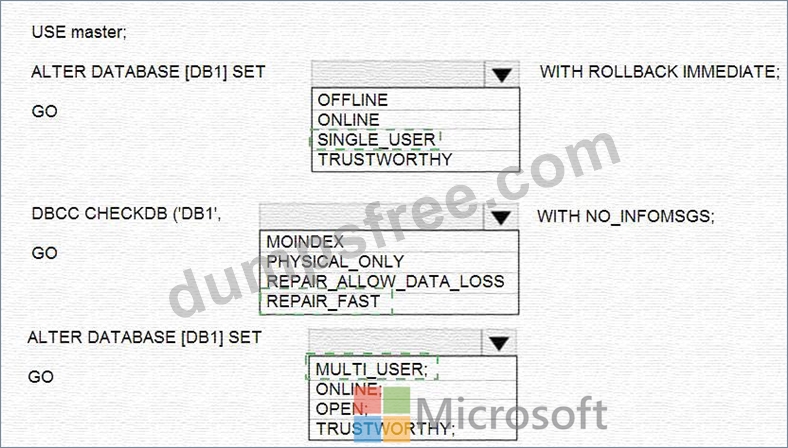
Explanation: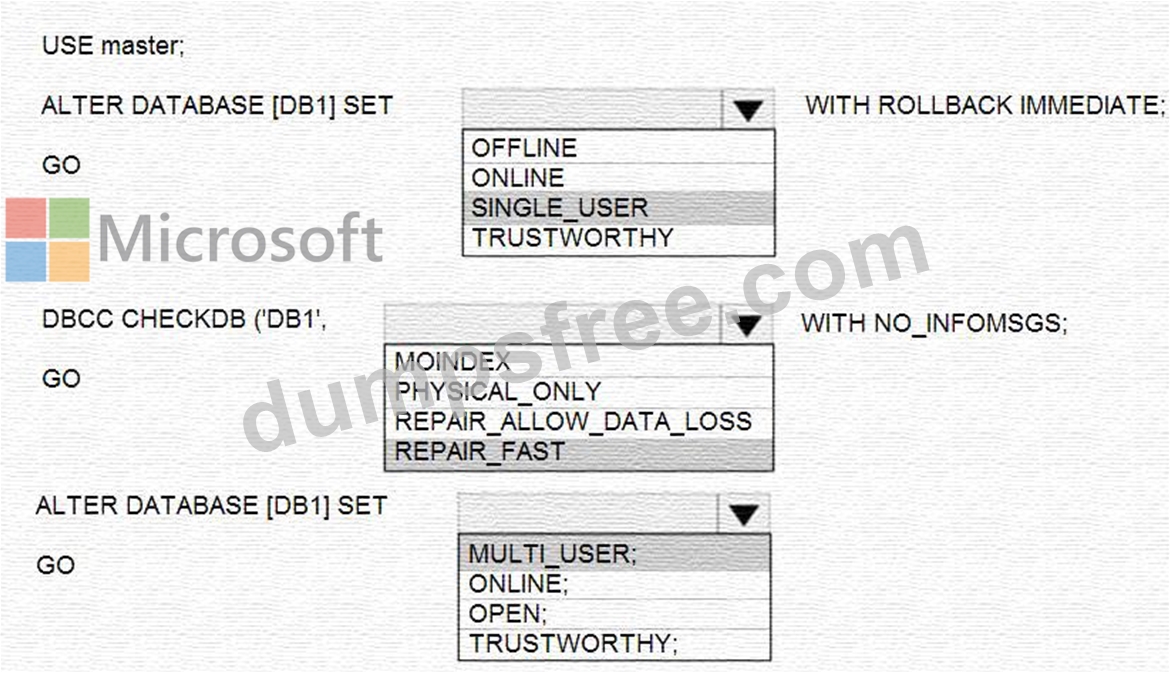
Box 1: SINGLE_USER
The specified database must be in single-user mode to use one of the following repair options.
Box 2: REPAIR_ALLOW_DATA_LOSS
REPAIR_ALLOW_DATA_LOSS tries to repair all reported errors. These repairs can cause some data loss.
Note: The REPAIR_ALLOW_DATA_LOSS option is a supported feature but it may not always be the best option for bringing a database to a physically consistent state. If successful, the REPAIR_ALLOW_DATA_LOSS option may result in some data loss. In fact, it may result in more data lost than if a user were to restore the database from the last known good backup.
Reference:
https://docs.microsoft.com/en-us/sql/t-sql/database-console-commands/dbcc-checkdb-transact-sql
NEW QUESTION # 253
You have an Azure SQL Database managed instance named sqldbmi1 that contains a database name Sales.
You need to initiate a backup of Sales.
How should you complete the Transact-SQL statement? To answer, select the appropriate options in the answer area.
NOTE: Each correct selection is worth one point.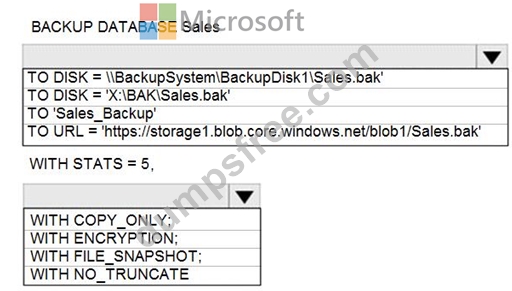
Answer:
Explanation: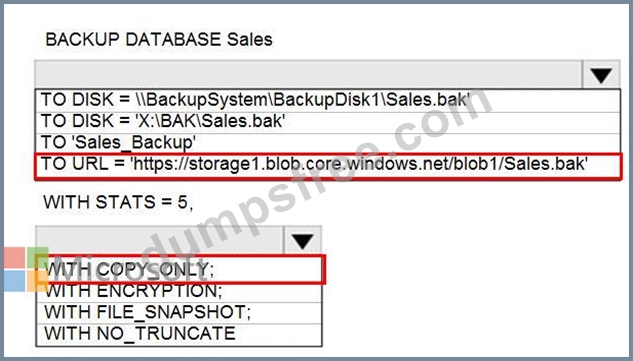
Explanation:
Box 1: TO URL = 'https://storage1.blob.core.windows.net/blob1/Sales.bak' Native database backup in Azure SQL Managed Instance.
You can backup any database using standard BACKUP T-SQL command:
BACKUP DATABASE tpcc2501
TO URL = 'https://myacc.blob.core.windows.net/testcontainer/tpcc2501.bak' WITH COPY_ONLY Box 2: WITH COPY_ONLY Reference:
https://techcommunity.microsoft.com/t5/azure-sql-database/native-database-backup-in-azure-sql-managed-instance/ba-p/386154
NEW QUESTION # 254
You have an Azure Databricks resource.
You need to log actions that relate to changes in compute for the Databricks resource.
Which Databricks services should you log?
- A. workspace
- B. clusters
- C. jobs
- D. DBFS
- E. SSH
Answer: A
Explanation:
Section: [none]
Explanation:
Cloud Provider Infrastructure Logs.
Databricks logging allows security and admin teams to demonstrate conformance to data governance standards within or from a Databricks workspace. Customers, especially in the regulated industries, also need records on activities like:
* User access control to cloud data storage
* Cloud Identity and Access Management roles
* User access to cloud network and compute
Azure Databricks offers three distinct workloads on several VM Instances tailored for your data analytics workflow-the Jobs Compute and Jobs Light Compute workloads make it easy for data engineers to build and execute jobs, and the All-Purpose Compute workload makes it easy for data scientists to explore, visualize, manipulate, and share data and insights interactively.
Reference:
https://databricks.com/blog/2020/03/25/trust-but-verify-with-databricks.html
NEW QUESTION # 255
You have an Azure subscription that contains a logical SQL server. The server hosts two databases named db1 and db2 and an Azure AD sen/ice principal named appl.
You need to ensure that appl can access db1. The solution must use the principle of least privilege.
How should you complete the Transact-SQL statement? To answer, select the appropriate options in the answer area.
NOTE: Each correct selection is worth one point.
Answer:
Explanation:
Explanation:
NEW QUESTION # 256
......
How to Register For Exam DP-300: Administering Relational Databases on Microsoft Azure?
Microsoft DP-300 Exam Practice Test Questions: https://dumpstorrent.dumpsfree.com/DP-300-valid-exam.html